
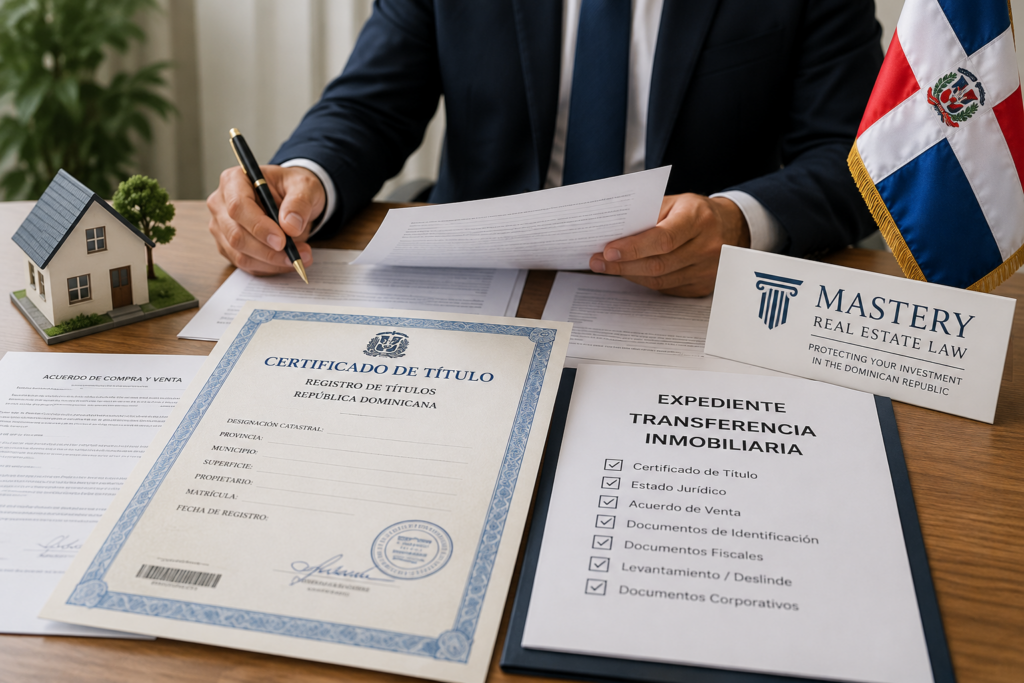
Documents Required for a Property Transfer in the Dominican Republic
Purchasing real estate in the Dominican Republic involves more than signing a purchase agreement. Before ownership can be legally transferred and registered in the buyer's name, buyers must satisfy several legal, tax, and administrative requirements. Understanding the documents required for a property transfer helps avoid delays, reduce legal risks, and ensure a smooth and secure transaction.
At Mastery Real Estate Law, we assist local and international clients with property transfers, title verification, legal due diligence, and real estate transactions throughout the Dominican Republic.
Why Documentation Matters in a Property Transfer
A property transfer is not completed simply because the parties agree to a sale.
Under Law No. 108-05 on Real Estate Registration, ownership rights over registered real estate are transferred through the Dominican land registration system after all legal requirements have been satisfied and the transaction has been properly registered.
Missing or inaccurate documentation is one of the most common causes of delays in Dominican real estate transactions.
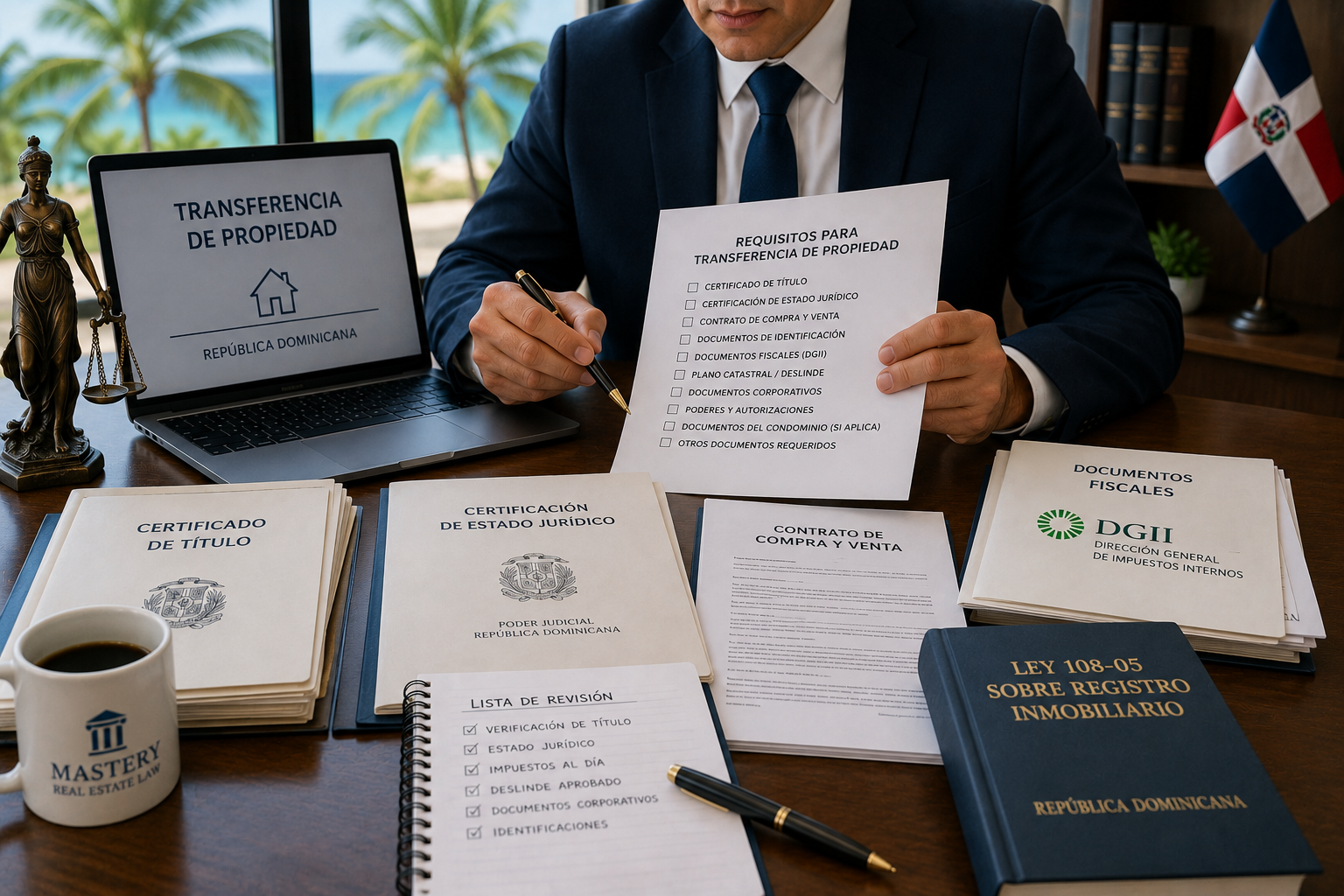
Reviewing Property Transfer Documentation Helps Verify Ownership Rights, Tax Compliance, and Legal Authority Before Completing a Real Estate Transaction in the Dominican Republic.
Essential Documents Required for a Property Transfer
The checklist below summarizes the documents most commonly required for residential real estate transfers in the Dominican Republic. Depending on the transaction, additional documentation may also be requested by the Registry of Titles or other government authorities.
Although every transaction is different, most residential real estate purchases in the Dominican Republic require many of the documents listed below. Buyers should verify that each document is current, complete, and legally valid before closing.
The exact documentation required may vary depending on the property and ownership structure. However, most transactions require the following documents.
1. Certificate of Title
The Certificate of Title is one of the most important documents in the transaction.
It serves as evidence of ownership and contains important information regarding:
- Registered owner.
- Parcel identification.
- Property registration details.
- Ownership rights.
The Certificate of Title should always be reviewed as part of the due diligence process.
Learn more in our guide "Understanding Certificates of Title in the Dominican Republic."
2. Certification of Legal Status (Certificación de Estado Jurídico)
This document is issued by the Registry of Titles and provides information regarding:
- Mortgages.
- Liens.
- Encumbrances.
- Court attachments.
- Registered claims.
- Ownership status.
Obtaining an updated Certification of Legal Status is an essential step before purchasing property.
Learn more in our guide "What Does Legal Due Diligence Include in the Dominican Republic?"
3. Purchase and Sale Agreement
The transfer process requires a properly executed purchase agreement.
Depending on the transaction, this may include:
- Promise of Sale Agreement.
- Purchase and Sale Agreement.
- Final Deed of Sale.
The agreement should clearly establish:
- Purchase price.
- Payment terms.
- Transfer obligations.
- Closing conditions.
- Default provisions.
Legal review of all contractual documentation is strongly recommended.
Learn more in our guide "Key Clauses Every Dominican Real Estate Purchase Agreement Should Include."
4. Identification Documents
Both buyer and seller must provide valid identification.
Examples include:
Individuals
- Dominican Cédula.
- Passport.
- Residency card (if applicable).
Foreign Buyers
- Valid passport.
- Additional identification when required.
Accurate identification is necessary for registration and tax compliance purposes.
5. Tax Documentation
Before the transfer can be completed, tax obligations must be reviewed.
This may include:
- DGII certifications.
- Property tax status.
- Transfer tax calculations.
- Tax exemption documentation (if applicable).
Under the Dominican Tax Code (Law No. 11-92), most property transfers are subject to a transfer tax equal to 3% of the property's assessed value.
Learn more in our guide "Closing Costs in the Dominican Republic: What Property Buyers Should Expect."
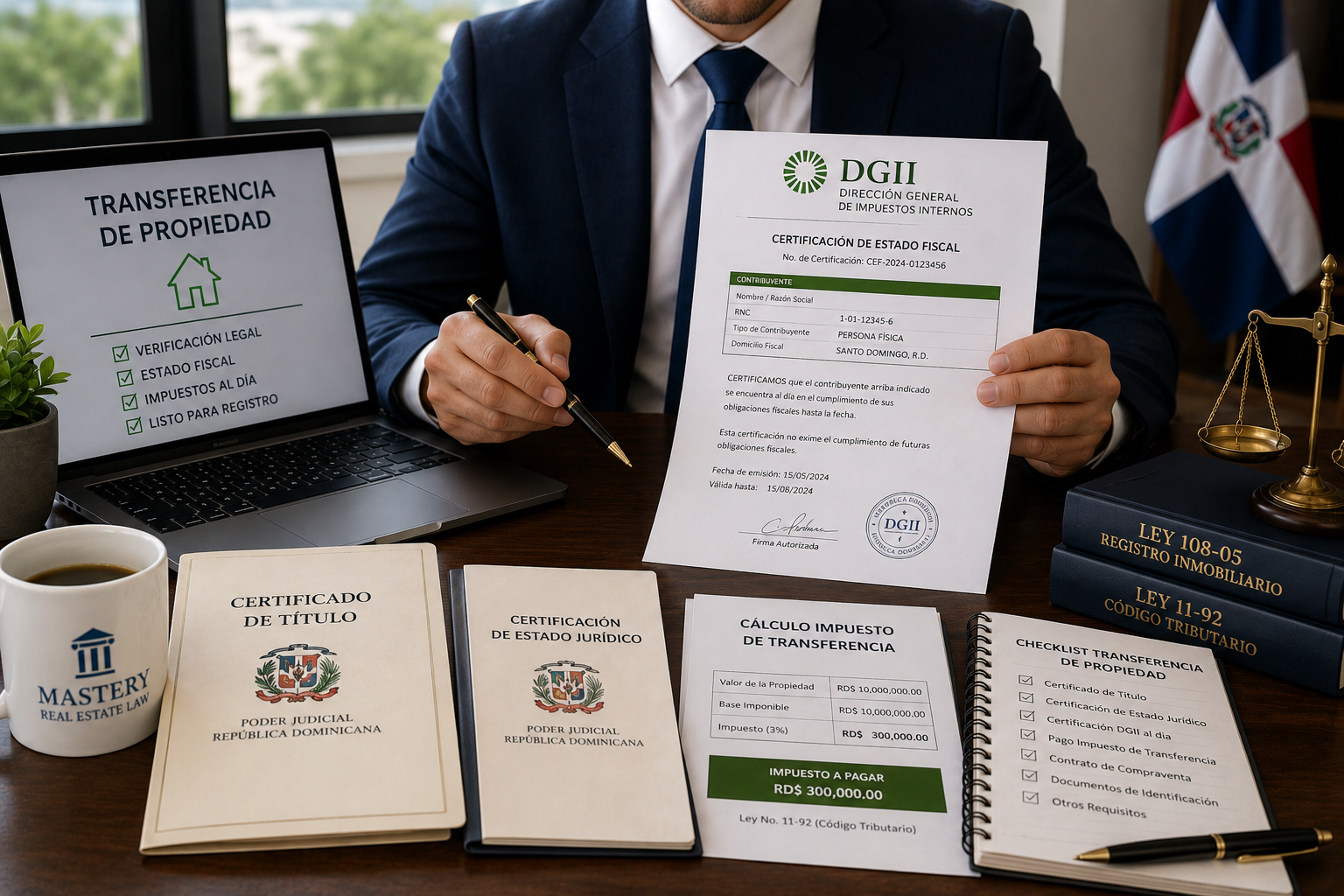
Verifying Tax Compliance with the DGII Helps Prevent Delays and Ensures That Property Transfers Can Be Properly Registered in the Dominican Republic.
6. Property Survey and Deslinde Documentation
Boundary verification is an important component of many transactions.
Documentation may include:
- Approved survey plans.
- Cadastral information.
- Deslinde documentation.
- Boundary certifications.
Properties with completed Deslinde procedures generally provide greater legal certainty.
Under Law No. 108-05 on Real Estate Registration, properly established boundaries play an important role in protecting ownership rights.
Learn more in our guide "Understanding the Deslinde Process in the Dominican Republic."
7. Corporate Documents (When the Seller Is a Company)
If the property is owned by a corporation, additional documentation will be required.
Typical documents include:
- Certificate of Commercial Registration.
- National Taxpayer Registry (RNC).
- Articles of Incorporation.
- Corporate resolutions authorizing the sale.
- Identification of authorized representatives.
The legal framework governing Dominican corporations is established primarily by Law No. 479-08 on Commercial Companies, as amended by Law No. 31-11.
When the seller is a corporation, buyers should verify that the person signing the transfer documents has legal authority to act on behalf of the company.
Failure to verify corporate authority may result in disputes regarding the validity of the transfer.
8. Proof of Corporate Authorization
Documentation may include:
- Shareholder resolutions.
- Board resolutions.
- Powers of attorney.
- Corporate authorizations.
This step is frequently overlooked but is extremely important.
9. Condominium and HOA Documentation
For condominium units and properties located within gated communities, buyers should request:
- Condominium declaration.
- Community regulations.
- HOA certifications.
- Maintenance fee statements.
- Financial obligation reports.
Outstanding obligations may affect the transaction.
10. Documents for Foreign Buyers
Depending on the specific transaction, foreign buyers may be required to provide additional documentation.
Examples include:
- Passport copies.
- Apostilled powers of attorney (if applicable).
- Corporate ownership documentation.
- International tax documentation when required.
Foreign buyers enjoy the same ownership rights as Dominican citizens and may acquire real estate directly in their own names.
Common Documentation Problems That Delay Transfers
Some of the most common issues include:
- Missing title documents.
- Expired certifications.
- Unresolved liens.
- Missing corporate approvals.
- Incomplete succession proceedings.
- Tax compliance issues.
- Boundary discrepancies.
- Inaccurate identification records.
Many of these problems can be identified through proper legal due diligence.
Why Legal Due Diligence Is Essential
Documentation alone is not enough.
A comprehensive due diligence investigation should verify:
- Ownership rights.
- Title status.
- Tax compliance.
- Boundary information.
- Corporate authority.
- Litigation risks.
Conducting proper due diligence before closing can significantly reduce legal and financial risks.
How Mastery Real Estate Law Can Help
At Mastery Real Estate Law, we assist clients with:
- Property transfers.
- Legal due diligence.
- Title verification.
- Contract review.
- Tax compliance review.
- Corporate ownership verification.
- Foreign investor representation.
- Real estate legal consulting.
Our goal is to help clients complete secure and legally compliant real estate transactions.
Preparing the required documentation before closing helps avoid unnecessary delays at the Registry of Titles and reduces the likelihood of disputes after the transaction has been completed.
Final Considerations
A successful property transfer depends largely on proper preparation and complete documentation.
Before purchasing property in the Dominican Republic, buyers should ensure that all ownership, tax, corporate, and registration requirements have been satisfied.
Property transfers should be evaluated in light of applicable Dominican legislation, including Law No. 108-05 on Real Estate Registration, Law No. 11-92 (Dominican Tax Code), and Law No. 479-08 on Commercial Companies, when corporate ownership structures are involved.
Obtaining professional legal guidance can help ensure a smooth transfer process and protect your investment.
Frequently Asked Questions
What documents are required for a property transfer in the Dominican Republic?
Most transactions require a Certificate of Title, Purchase and Sale Agreement, identification documents, tax documentation, and Registry of Titles records. Additional documents may be required depending on the transaction.
Do foreign buyers need additional documents?
Yes. Foreign buyers generally provide a valid passport and, when applicable, apostilled powers of attorney or corporate documentation.
Is a Certificate of Title required?
Yes. The Certificate of Title is one of the primary documents used to verify ownership before a property transfer.
What happens if documents are missing?
Missing or outdated documents can delay the registration process and may prevent ownership from being transferred until the deficiencies are resolved.
Is legal due diligence part of the property transfer process?
Yes. Legal due diligence helps verify ownership, review legal documents, identify risks, and ensure the property can be legally transferred.
Who registers the property transfer?
The transfer is registered before the Dominican Registry of Titles after all legal and tax requirements have been satisfied.
Contact Mastery Real Estate Law
If you are buying or selling property in the Dominican Republic, Mastery Real Estate Law can assist you with title verification, legal due diligence, contract review, tax compliance, and the complete property transfer process from beginning to end.
Published by Mastery Real Estate Law
Protecting Your Investment in the Dominican Republic.