
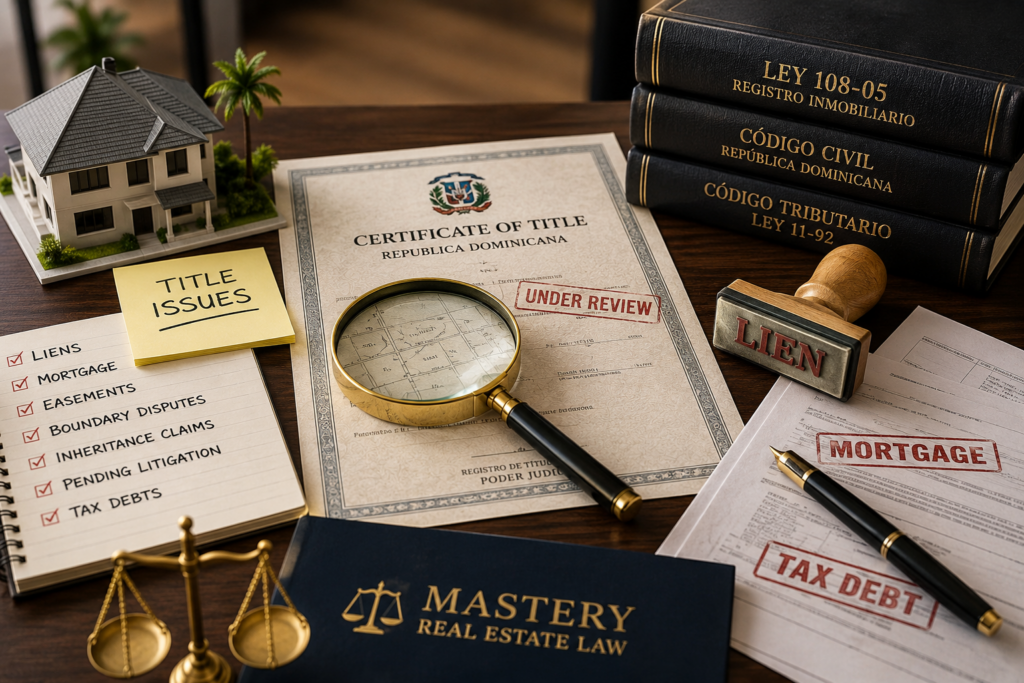
Common Title Problems Found During Property Purchases in the Dominican Republic
Before purchasing real estate, buyers should understand the most common title problems in the Dominican Republic. Identifying ownership disputes, liens, boundary issues, and other title defects through legal due diligence can help prevent costly delays and protect your investment.
Common title problems can significantly affect real estate transactions in the Dominican Republic. Before purchasing property, buyers should verify that the title is free from liens, ownership disputes, boundary issues, inheritance claims, and other legal defects that could delay the transfer or affect ownership rights.
Purchasing real estate in the Dominican Republic can be an excellent investment opportunity. However, even properties that appear attractive and well-priced may contain title-related issues that can delay a transaction, increase legal costs, or create ownership disputes.
Many of these problems are not visible during a property showing and can only be identified through proper legal due diligence and title verification.
At Mastery Real Estate Law, we assist buyers, investors, and property owners in identifying and resolving title-related issues before completing a real estate transaction.
What Are Common Title Problems?
A title issue, sometimes referred to as a title defect or cloud on title, is any legal problem that may affect ownership rights or restrict the ability to transfer property.
Title issues may:
- Delay a closing.
- Prevent a property transfer.
- Create ownership disputes.
- Affect financing approvals.
- Reduce the property's market value.
Under Law No. 108-05 on Real Estate Registration, ownership rights over registered real estate are generally evidenced through a valid Certificate of Title issued by the Dominican land registration system.
For this reason, title verification is one of the most important steps in any real estate transaction.
Learn more in our guide "Understanding Certificates of Title in the Dominican Republic."

Title Verification and Legal Due Diligence Help Identify Ownership Issues, Liens, and Other Risks Before Purchasing Property in the Dominican Republic.
1. Outstanding Liens and Encumbrances
One of the most common title problems involves the existence of liens or encumbrances affecting the property.
These may include:
- Mortgages.
- Tax liens.
- Court-ordered attachments.
- Judgments.
- Other registered claims.
A property may appear to have a clear title while still being subject to legal restrictions that affect ownership or transferability.
Obtaining a current Certificación de Estado Jurídico is often an essential step in identifying these issues before closing.
Learn more in our guide "How to Check for Liens and Encumbrances in the Dominican Republic."
2. Inheritance and Succession Issues
Inheritance-related problems are among the most frequent causes of title disputes in the Dominican Republic.
Common situations include:
- Uncompleted succession proceedings.
- Unidentified heirs.
- Disputes among family members.
- Property registered in the name of a deceased owner.
Under Article 718 of the Dominican Civil Code, succession opens upon the death of the property owner.
Until the proper succession process is completed, transferring ownership may be difficult or impossible.
3. Boundary and Survey Problems
Property boundary disputes may arise when:
- Property limits are unclear.
- Surveys are outdated.
- Neighboring owners challenge boundaries.
- Encroachments exist.
In some cases, buyers discover after closing that structures extend beyond legal property boundaries or that portions of the property are subject to competing claims.
Proper survey review and boundary verification are essential parts of legal due diligence.
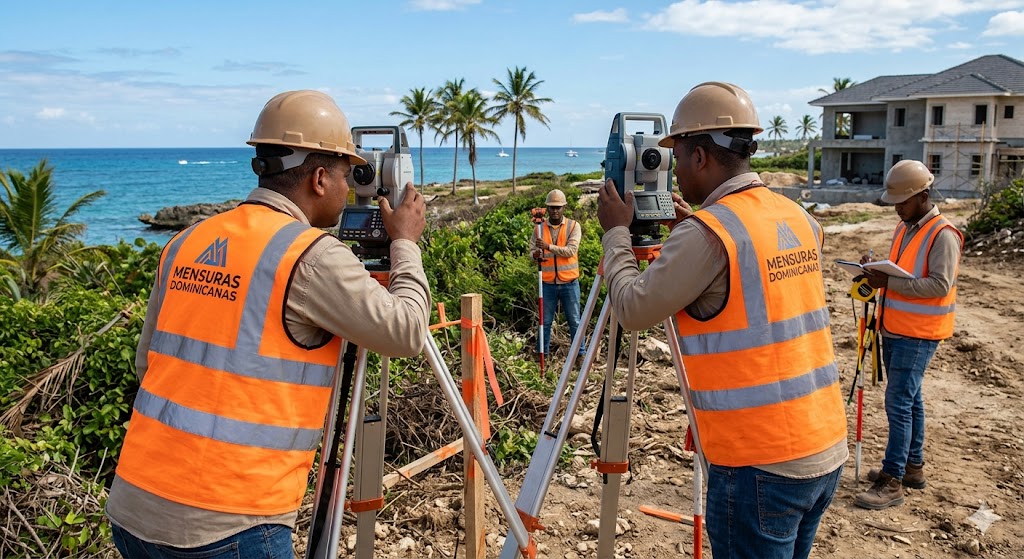
Accurate Boundary Verification Helps Prevent Ownership Disputes and Protect Property Rights Under Dominican Real Estate Law.
4. Properties Without a Completed Deslinde
Some properties remain registered under forms of ownership that have not yet undergone complete boundary determination procedures.
These situations may create uncertainty regarding:
- Exact property dimensions.
- Ownership limits.
- Future subdivision possibilities.
- Development rights.
Investors should carefully review boundary status before purchasing property, particularly when acquiring development land
5. Ownership Chain Irregularities
The ownership history of a property should be carefully reviewed.
Potential issues may include:
- Missing ownership records.
- Improper transfers.
- Incomplete registrations.
- Unrecorded transactions.
- Gaps in the ownership chain.
A thorough review of historical ownership documentation can help identify potential risks before closing.
6. Corporate Ownership Problems
Many Dominican properties are owned by corporations.
Before purchasing property from a corporation, buyers should verify:
- Corporate existence.
- Shareholder authority.
- Corporate resolutions.
- Legal authority to sell.
The legal framework governing Dominican corporations is primarily established by Law No. 479-08 on Commercial Companies, as amended by Law No. 31-11.
Failure to verify corporate authority may result in disputes regarding the validity of the transaction.
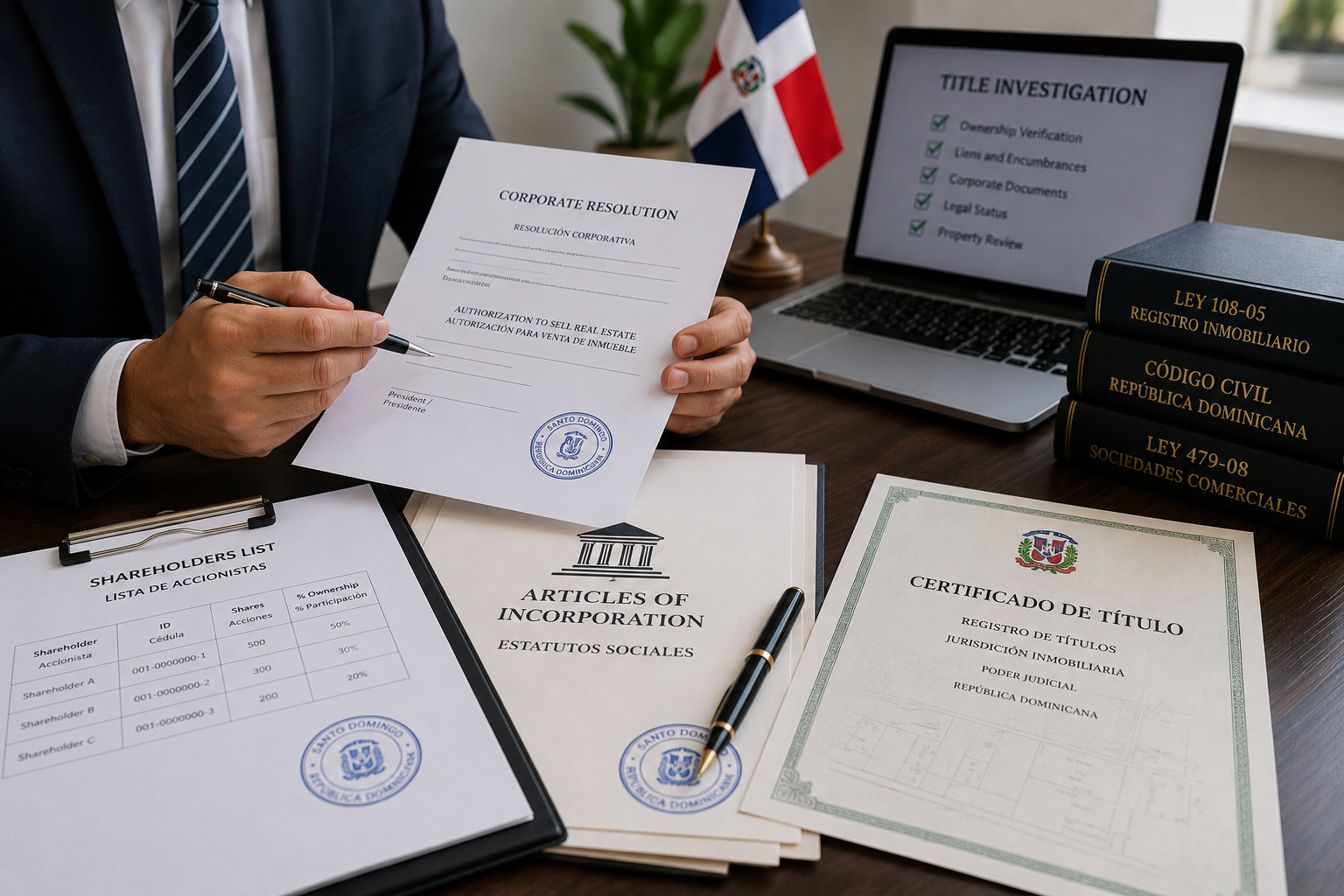
Verifying Corporate Authority and Ownership Rights Is Essential When Acquiring Real Estate Held by a Dominican Corporation.
7. Matrimonial Property Issues
In certain circumstances, marital property rights may affect ownership and transferability.
Potential issues include:
- Missing spousal consent.
- Community property claims.
- Unresolved divorce-related property rights.
These matters should be evaluated during the due diligence process to ensure that all required parties participate in the transaction.
8. Tax-Related Problems
Outstanding tax obligations may affect the transfer of property.
Buyers should verify:
- Property tax status.
- Municipal obligations.
- Transfer tax requirements.
- Applicable exemptions.
Proper tax verification can help avoid unexpected liabilities after closing.
9. Fraudulent or Defective Documentation
Real estate transactions occasionally involve:
- Invalid powers of attorney.
- Incorrect corporate documents.
- Forged signatures.
- Defective legal instruments.
Document authenticity should always be verified before funds are transferred.
10. Pending Litigation Affecting the Property
A property may be involved in legal proceedings that affect ownership rights.
Examples include:
- Ownership disputes.
- Inheritance litigation.
- Contract claims.
- Boundary disputes.
Pending litigation can significantly affect the value and marketability of real estate assets.
Why Legal Due Diligence Matters
Many title problems can be identified before closing through proper legal due diligence.
A comprehensive review typically includes:
- Certificate of Title verification.
- Ownership confirmation.
- Review of liens and encumbrances.
- Boundary verification.
- Corporate review (when applicable).
- Tax verification.
- Contract review.
Identifying title issues before closing is generally far less costly than attempting to resolve them after acquiring the property.
Learn more in our guide "What Does Legal Due Diligence Include in the Dominican Republic?"
Buyers who identify title problems early are in a much stronger position to negotiate with the seller, request corrective measures, or avoid transactions that present unacceptable legal risks. Professional legal due diligence remains the most effective way to protect a real estate investment in the Dominican Republic.
How to Avoid Title Problems
Verify the Certificate of Title. Obtain a current Certificación de Estado Jurídico. Review the Complementary Registry. Verify property boundaries. Conduct legal due diligence. Review tax compliance. Work with an experienced Dominican real estate attorney.
Frequently Asked Questions
What are title problems?
Title problems are legal issues that may affect ownership rights or restrict the transfer of real estate. Common title problems include active mortgages, liens, ownership disputes, boundary conflicts, inheritance issues, easements, and incomplete or inaccurate property records.
Can a property have a valid Certificate of Title and still have problems?
Yes. A valid Certificate of Title confirms registered ownership, but it does not necessarily mean the property is free from mortgages, liens, easements, court claims, or other legal encumbrances. A complete legal due diligence investigation is recommended before purchasing property.
How can I verify a property's title?
A property's title should be verified through a legal review of the Certificate of Title, the Certificación de Estado Jurídico del Inmueble, the Complementary Registry, and other relevant land registry records. An experienced real estate attorney can also verify ownership, identify encumbrances, and review the property's legal status.
Can title problems delay a property transfer?
Yes. Title problems such as unresolved liens, active mortgages, inheritance disputes, boundary issues, or incomplete documentation may delay or even prevent the transfer of ownership until the issues have been resolved.
What is the most common title problem in the Dominican Republic?
Some of the most common title problems include active mortgages, registered liens, ownership disputes, unresolved succession proceedings, boundary conflicts, and incomplete or outdated property records. Proper legal due diligence can help identify these issues before closing.
Can foreigners protect themselves against title problems?
Yes. Foreign buyers can reduce legal risks by working with a qualified Dominican real estate attorney who performs legal due diligence, verifies the Certificate of Title, reviews registry records, confirms tax compliance, and identifies potential title defects before the transaction is completed.
How Mastery Real Estate Law Can Help
At Mastery Real Estate Law, we assist clients with:
- Title verification.
- Legal due diligence.
- Property transfers.
- Real estate acquisitions.
- Inheritance-related real estate matters.
- Corporate ownership review.
- Foreign investor representation.
Our goal is to help clients identify legal risks before they become costly disputes.
Learn more in our guide "Property Transfers in the Dominican Republic."
Final Considerations
Title issues can affect any real estate transaction, regardless of the property's location or value.
Before purchasing property in the Dominican Republic, buyers should conduct proper legal due diligence and obtain professional legal advice to verify ownership rights and identify potential risks.
Real estate transactions should be evaluated in light of applicable Dominican legislation, including Law No. 108-05 on Real Estate Registration, the Dominican Civil Code, and Law No. 479-08 on Commercial Companies, when corporate ownership structures are involved.
Taking the time to verify title status before closing can help protect your investment and reduce the likelihood of future legal disputes.
Contact Mastery Real Estate Law
If you are considering purchasing property in the Dominican Republic, our team can assist you with title verification, legal due diligence, contract review, and real estate transactions throughout the country.
Published by Mastery Real Estate Law
Protecting Your Investment in the Dominican Republic.