
How to Obtain a Certified Copy of a Certificate of Title in the Dominican Republic
The Certificate of Title is one of the most important legal documents in any real estate transaction in the Dominican Republic. It serves as official proof of ownership and contains essential information regarding the property, including the owner's name, property description, cadastral designation, and any registered encumbrances or liens.
To better understand how ownership is verified, read our guide "How to Verify a Property Title in the Dominican Republic."
Whether you are selling a property, conducting due diligence, applying for financing, handling an inheritance matter, or verifying ownership rights, obtaining a certified copy of the Certificate of Title is often a necessary step.
At Mastery Real Estate Law, we assist property owners, investors, heirs, and foreign buyers in obtaining certified title documents and verifying the legal status of real estate throughout the Dominican Republic.

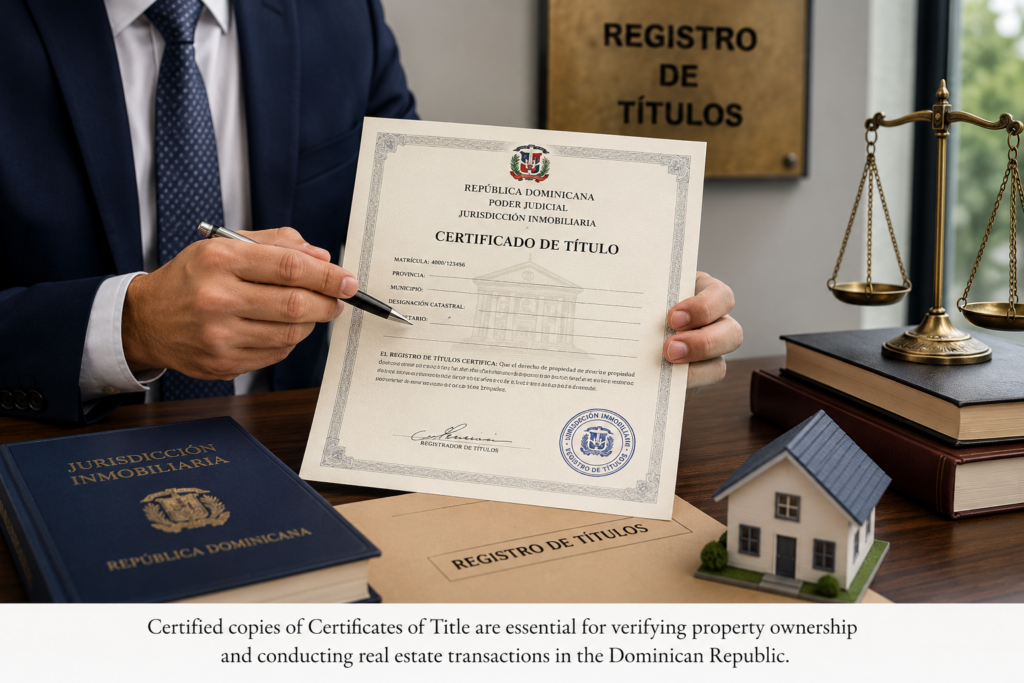
Certified copies of Certificates of Title are essential for verifying property ownership, conducting due diligence, and completing real estate transactions in the Dominican Republic.
What Is a Certified Copy of a Certificate of Title?
A certified copy is an official reproduction of the Certificate of Title issued by the corresponding Registry of Titles (Registro de Títulos).
Unlike a simple photocopy, a certified copy carries legal validity because it is issued and authenticated by the competent authority within the Dominican Land Registration System.
Certified copies are frequently required for:
- Real estate sales and transfers
- Property due diligence investigations
- Mortgage applications
- Inheritance proceedings
- Judicial proceedings involving real estate
- Property disputes
- Corporate real estate transactions
- Tax and administrative procedures
Legal Framework Governing Certificates of Title
The Dominican real estate registration system is primarily governed by:
Law No. 108-05 on Real Estate Registration
Law 108-05 establishes the legal framework for the registration, transfer, and protection of real property rights in the Dominican Republic.
Under this law, the Registry of Titles is responsible for maintaining official records of ownership rights and issuing certified title documents.
General Regulations of the Real Estate Jurisdiction
The General Regulations of the Real Estate Jurisdiction complement Law 108-05 by regulating procedures related to property registration, certification requests, and access to real estate records.
These regulations guarantee transparency, legal certainty, and public access to registered property information.
Who Can Request a Certified Copy?
In most cases, certified copies may be requested by:
- Registered property owners
- Authorized legal representatives
- Attorneys acting under a valid power of attorney
- Heirs with a legitimate legal interest
- Financial institutions
- Courts and government authorities
- Individuals or entities demonstrating a legitimate interest in the property
The Registry of Titles may require identification and supporting documentation before issuing the certification.
Information Needed to Request a Certified Copy
To facilitate the search, applicants should provide as much information as possible, including:
Property Information
- Certificate of Title number
- Property designation
- Cadastral reference
- Parcel number
- Condominium unit information (if applicable)
Owner Information
- Full legal name of the registered owner
- Identification number (Cedula or Passport)
- Corporate registration information for legal entities
Providing accurate information helps reduce delays and ensures the correct document is located.
Where Is the Request Submitted?
Applications are submitted to the Registry of Titles that has jurisdiction over the location of the property.
For example:
- Registry of Titles of Higüey
- Registry of Titles of Santo Domingo
- Registry of Titles of Santiago
- Registry of Titles of La Romana
- Registry of Titles of Puerto Plata
The appropriate office depends on the property's geographic location.

Applicants must submit the required information and supporting documents to the appropriate Registry of Titles to obtain a certified copy of a Certificate of Title.
Steps to Obtain a Certified Copy
Step 1: Gather Property Information
Collect all available information related to the property, including title numbers, cadastral references, and ownership details.
Step 2: Prepare Identification Documents
Applicants should present valid identification and any supporting documentation demonstrating their legal interest when required.
Step 3: Submit the Request
The request is filed before the corresponding Registry of Titles either personally, through legal counsel, or through authorized representatives.
Step 4: Pay Applicable Administrative Fees
Government fees may apply depending on the type of certification requested and current administrative regulations.
Step 5: Receive the Certified Copy
Once processed, the Registry of Titles issues the certified document, which may be used for legal, financial, or administrative purposes.
How Long Does the Process Take?
Processing times vary depending on:
- The Registry of Titles involved
- Current administrative workload
- Accuracy of the information provided
- Complexity of the property records
Straightforward requests are often processed within a few business days, although more complex cases may require additional time.
Why Is a Certified Copy Important During Due Diligence?
Obtaining a certified copy is one of the first steps in any real estate due diligence investigation.
A current certified title allows attorneys and investors to verify:
- Ownership rights
- Existing mortgages
- Liens and encumbrances
- Court orders affecting the property
- Restrictions on transfer
- Property descriptions and boundaries
Without reviewing a certified title, buyers risk acquiring property with hidden legal issues.
Learn more about the legal review process in our article "Legal Due Diligence in Real Estate Transactions in the Dominican Republic."
Common Situations Requiring a Certified Copy
Property owners and investors frequently request certified copies in the following situations:
Property Sale
To demonstrate ownership before transferring the property.
Mortgage Financing
Banks commonly require certified title documents before approving loans.
Inheritance Proceedings
Heirs must verify ownership and identify registered real estate assets.
Corporate Transactions
Companies purchasing or selling property often require certified title verification.
Property Disputes
Certified title documents serve as key evidence in litigation involving ownership rights.
Legal Assistance Can Simplify the Process
Although obtaining a certified copy is generally straightforward, complications can arise when:
- Ownership records are outdated
- Names appear incorrectly registered
- Multiple owners are involved
- Succession proceedings remain unresolved
- Property records contain inconsistencies
An experienced real estate attorney can help resolve these issues and ensure the correct documentation is obtained efficiently.
Final Considerations
Obtaining a certified copy of a Certificate of Title is a fundamental step in protecting and verifying real estate ownership in the Dominican Republic. Whether you are buying, selling, inheriting, financing, or investigating a property, certified title documentation provides the legal certainty necessary to proceed with confidence.
Understanding the procedures established by Law 108-05 and the regulations governing the Dominican Real Estate Jurisdiction can help property owners and investors avoid delays and ensure that their rights are properly protected.
Need Assistance Obtaining a Certified Copy of a Certificate of Title?
At Mastery Real Estate Law, we assist clients with title verification, due diligence investigations, property transfers, inheritance matters, and all aspects of Dominican real estate law.
Contact us today to ensure your property rights are fully protected.